
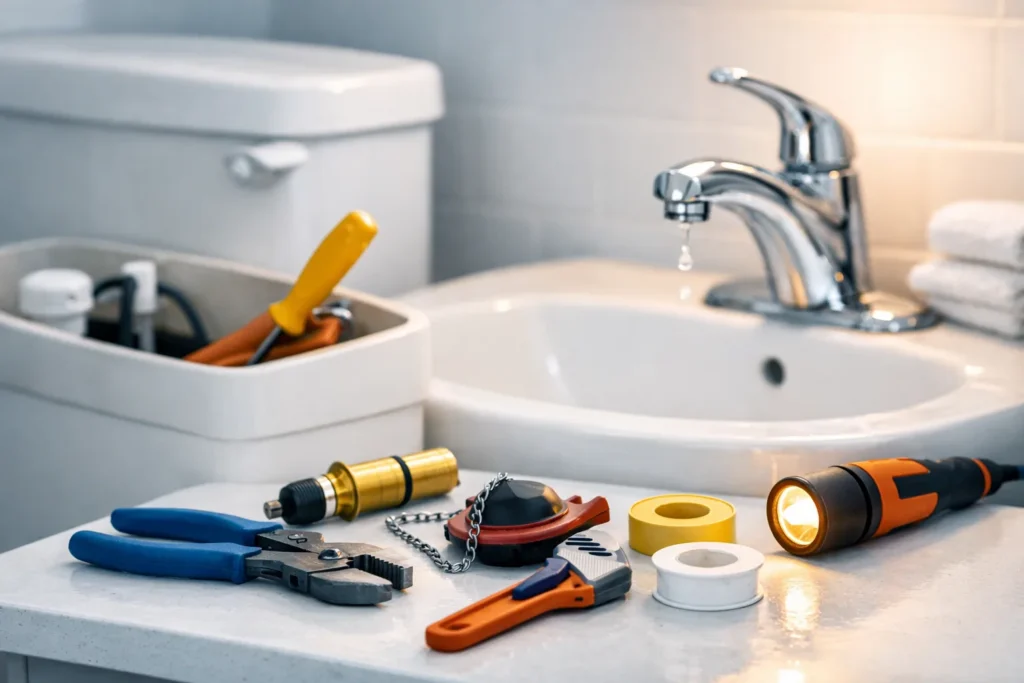
A toilet that keeps running or a faucet that drips all night is more than an annoyance. The EPA’s WaterSense program notes that even small leaks add up to thousands of gallons wasted over a year, and a dripping faucet can lose roughly 3,000 gallons a year. The good news is that most of these problems involve one inexpensive part and a basic toolkit.
Start by shutting off the water
Before you open anything, find the shutoff valve. For a toilet, it is on the wall or floor behind the bowl; for a sink, it is under the basin. Turn it clockwise until it stops. If the valve is stuck or leaks when you turn it, stop and call a plumber, because forcing it can make things worse. Texas homes in older neighborhoods sometimes have corroded valves that fail when moved after years of sitting.
Diagnose before you buy parts
Match the symptom to the likely part.
| Problem | Likely part | Tool needed | Time |
|---|---|---|---|
| Toilet runs after flushing | Flapper that no longer seals | Hands, sometimes a sponge | 15 to 30 minutes |
| Toilet fills, then fills again every few minutes | Worn flapper or flush valve seat | Hands, replacement flapper | 20 to 40 minutes |
| Water runs constantly and the tank never stops filling | Fill valve or float set too high | Adjustable wrench, screwdriver | 30 to 60 minutes |
| Faucet drips from the spout | Worn washer, cartridge, or O-ring | Screwdriver, adjustable wrench, replacement part | 30 to 60 minutes |
| Water pools at the base of the faucet handle | Worn O-ring or packing nut | Wrench, small replacement ring | 20 to 40 minutes |
Fixing a running toilet
First, the dye test. Put a few drops of food coloring in the tank, wait 10 to 15 minutes without flushing, and look in the bowl. If color appears, water is leaking past the flapper, the rubber piece at the bottom of the tank.
- Turn off the water and flush to drain the tank.
- Unhook the flapper chain and lift off the flapper from its pegs.
- Check the flush valve seat, the ring beneath, for crust or mineral buildup. Wipe it with a cloth.
- Bring the old flapper with you or note its brand and style to get a matching replacement.
- Attach the new flapper, adjust the chain so it has a little slack, then turn the water on and test.
If the tank keeps filling and water spills into the overflow tube, lower the float or adjust the fill valve according to its instructions until the water level sits about 1 inch below the top of the tube.
Fixing a dripping faucet
- Close the shutoff valves under the sink and open the faucet to release pressure.
- Plug the drain so small parts cannot fall in.
- Remove the handle by popping off the cap and unscrewing the screw beneath.
- Use a wrench to remove the packing nut or cartridge, depending on your model.
- Inspect the washer, O-ring, or cartridge. If worn or cracked, replace with an exact match.
- Reassemble, turn the water on slowly, and check for drips.
Take a photo at each step so you remember the order of parts. If you rent, tell your landlord first; in Texas, repairs of this kind are normally the landlord’s responsibility under the lease and state law, and fixing it yourself may void a warranty or cause a dispute.
Know when to call a plumber
Call a professional if you see water stains on the ceiling below, if a shutoff valve will not close, if a pipe is corroded or leaking, or if the problem returns after you replace the part. Also call one if you smell sewage, or if parts do not match what you find. A repair that takes you an hour of frustration may take a plumber ten minutes.
Save water going forward
Check your toilet with the dye test twice a year and listen for hissing after a flush. WaterSense-labeled fixtures are certified to use less water than standard models, and a replacement can pay back over time. For other small fixes around the house, see Cleaning and upkeep.