



In a small Seattle rental, the floor under your bed may be the largest unused storage area you have. It is also the easiest to get wrong. People buy a set of bins, push them under the frame, and discover that two do not fit and the rest scrape the headboard. A few measurements before you shop save the return trip.
Measure the space before you buy anything
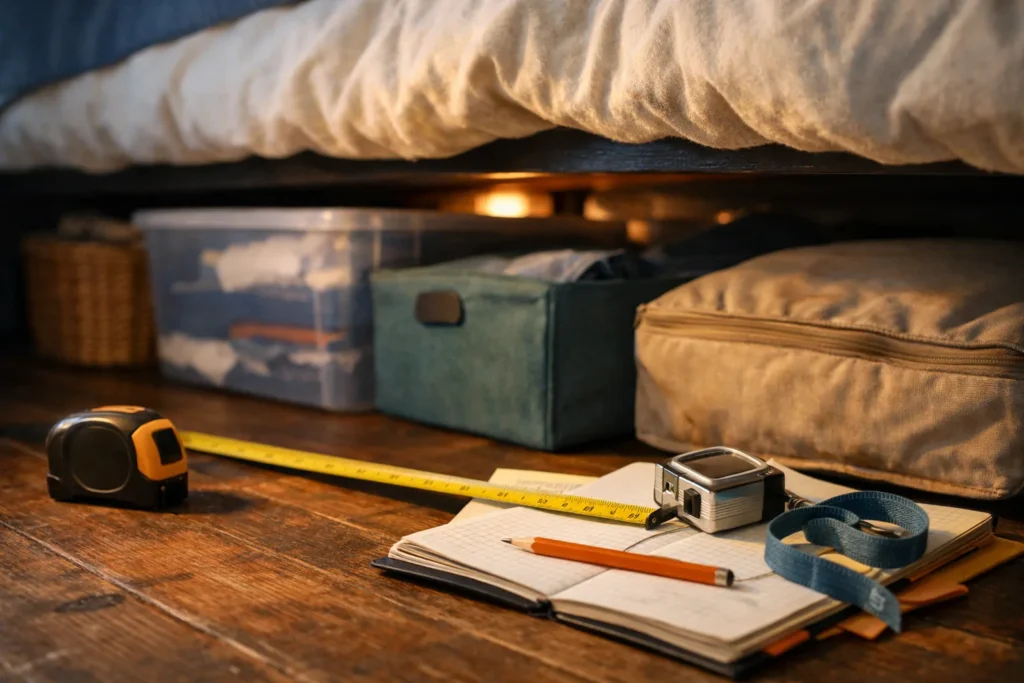
Grab a tape measure and a notepad. You need three numbers, and you need them for the actual bed you sleep on, not a bed you imagine owning later.
- Clearance height. Measure from the floor to the lowest point of the frame or slats. Many rental bed frames leave about 7 to 9 inches (18 to 23 cm); bed frames with legs or a box spring on risers can offer 12 to 18 inches (30 to 46 cm). Measure at the narrowest spot, because a center support bar often cuts the opening.
- Depth. Measure from the edge of the bed to the wall or headboard. In a narrow bedroom this is usually 60 to 80 inches (152 to 203 cm), but a footboard or a baseboard heater can shorten it.
- Width of each opening. If a center rail splits the space, measure each side separately.
Write the numbers down, then subtract about 1 inch from the height and 2 inches from the depth so a bin can slide in and out without catching. A bin that clears by a quarter inch will jam the first time a sock hangs over the edge.
Match the container to the clearance
Once you know the height, the choice gets simple.
- Under 6 inches (15 cm): flat zip bags or fabric sleeves for flat blankets, a winter coat compressed in a vacuum-style bag, or a shallow cardboard flat for wrapping paper and cards.
- 6 to 10 inches (15 to 25 cm): shallow plastic bins with wheels. This is the sweet spot for sweaters, extra sheets, and off-season shoes.
- 10 inches and up: deeper bins for bulky items such as comforters, or two shallow bins stacked if the lids are sturdy.
Wheels help in a rental with hardwood or laminate floors, but check that the casters do not leave marks. If you rent, a thin piece of felt under hard wheels protects the finish and your deposit.
Decide what lives down there
The best under-bed items are things you need a few times a year, not every morning. Think extra bedding, guest towels, out-of-season clothing, and memorabilia you want to keep but not display. Skip anything you reach for daily; if it takes more than ten seconds to retrieve, it will end up on a chair.
Avoid storing food, candles, anything that can melt, and anything you would hate to find damp. Do not store loose papers there either, because paper takes in moisture and absorbs odors.
Plan a seasonal rotation
A rotation keeps the space working all year. Twice a year, once in early spring and once in early fall, pull everything out and swap.
- In October, bring up wool sweaters and the heavier duvet; send summer dresses and shorts down.
- In April, reverse it.
- Each time, check each bin for damp spots, loose threads, or a musty smell before you put it back.
Take the opportunity to hold each item and ask whether you wore or used it this season. Anything you skipped twice is a candidate for donation, which also makes room for next year.
Keep dust and moisture in check
Seattle and the wider Pacific Northwest climate bring long damp stretches from fall to spring, and the air under a bed does not move much. Dust collects there quickly, and a closed room with little ventilation can hold moisture against the floor.
The U.S. Environmental Protection Agency advises keeping indoor relative humidity between roughly 30 and 50 percent to discourage mold and dust mites. A small hygrometer, which costs very little, tells you where you stand. If the reading stays above 60 percent, run the bathroom fan after showers, crack a window on dry afternoons, and think twice about storing fabric that is not fully dry.
Choose lidded bins for textiles, and add a clean cotton pillowcase or an old sheet as a liner so wool does not touch plastic directly. Vacuum under the bed every month or two; the bins make that easy because you can slide them out in a minute. For the cleaning side of this routine, see the guides in Cleaning and upkeep.
A quick final check
Before you commit, slide one empty bin into place, then try opening it halfway. If you can lift the lid and reach in without moving the bed, the size works. If you have to drag the bed away from the wall every time, buy a shallower bin. Label the end that faces you, since you will not see the lid, and keep a simple list on your phone of what is in which bin.