




Most arguments about housework are not about the dishes. They are about a feeling that the work is invisible or unevenly shared. A chart ends the guessing: it puts every task on paper, assigns it, and moves it along each week. Government time-use data gives you a useful starting point for what the work actually involves.
What the time-use survey tells you
The Bureau of Labor Statistics runs the American Time Use Survey, which asks thousands of Americans to account for a full day, hour by hour. Among the categories it tracks are household activities: cleaning, laundry, cooking, lawn care, and household management. Year after year the results show a consistent pattern. On an average day, a large share of adults do some kind of housework, and on average women report spending more time on it than men do. Food preparation and cleanup, interior cleaning, and laundry take up most of the hours.
You do not need the exact figures to use the lesson. The big recurring jobs are meals, dishes, laundry, and tidying. Those are the ones that wear people down, so they are the ones to share first.
List every task before you divide anything
Sit down with the whole family, kids included, and write each recurring job on a sticky note or a sheet of paper. Group them in three types.
- Daily: dishes, wiping counters, making beds, sorting mail, meals.
- Weekly: laundry, vacuuming, bathrooms, trash and recycling, changing sheets, grocery pickup.
- Occasional: windows, refrigerator shelves, closets, yard work.
Seeing the whole list often surprises the adults. Tasks like planning meals, keeping the school calendar, and remembering the dentist appointments are real work, so put them on the chart too.
Split by time and ability, not by habit
For a family of four, say two adults and two school-age children, aim for a fair split of minutes rather than a fair split of tasks. A twenty-minute bathroom clean is not equal to a five-minute trash run. Estimate how long each task takes, then give each adult a similar weekly total and each child a smaller share fitted to their age.
Let each person pick a few jobs first. People stick with chores they chose. Then fill in the rest by negotiation, and note anything that nobody wants so you can rotate it.
Build a simple weekly layout
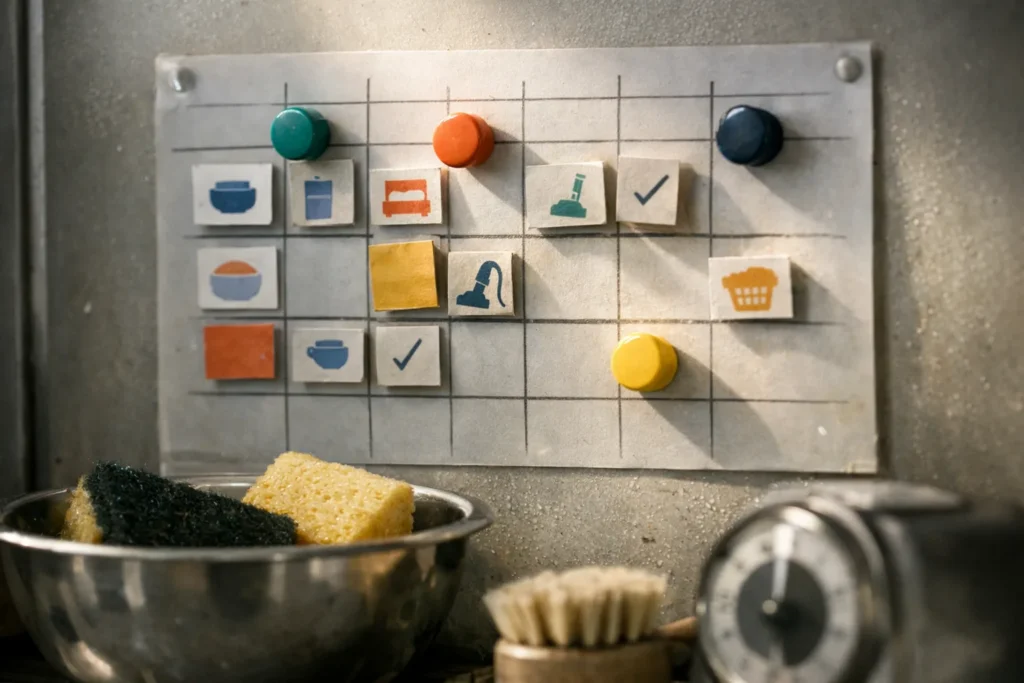
A grid with the days across the top and names down the side is enough. Here is a rotation that works for many families.
- Monday: kitchen reset and trash night.
- Tuesday: one load of laundry started and folded; one bathroom.
- Wednesday: vacuum the main living areas.
- Thursday: second laundry load and sheets.
- Friday: clear clutter and pick up the entry.
- Saturday: a 30-minute family blitz for the occasional jobs.
- Sunday: rest, with a short planning check-in.
Each week, shift the names one column over so no one is stuck with the bathrooms forever. Daily jobs like dishes can follow a simple pattern: one person cooks, another cleans up, and they swap the next day.
Keep it visible and short
Post the chart where everyone passes it, such as the refrigerator or a hallway board. Use checkmarks for younger kids. Hold a five-minute review each Sunday to adjust: if a task keeps getting skipped, either it is too much or it is not clear who owns it.
Finally, aim for done, not perfect. A chart that saves an hour of tension a week is doing its job. For ideas on what children can handle at each age, see Home organization and the guides in this section on age-appropriate chores.