


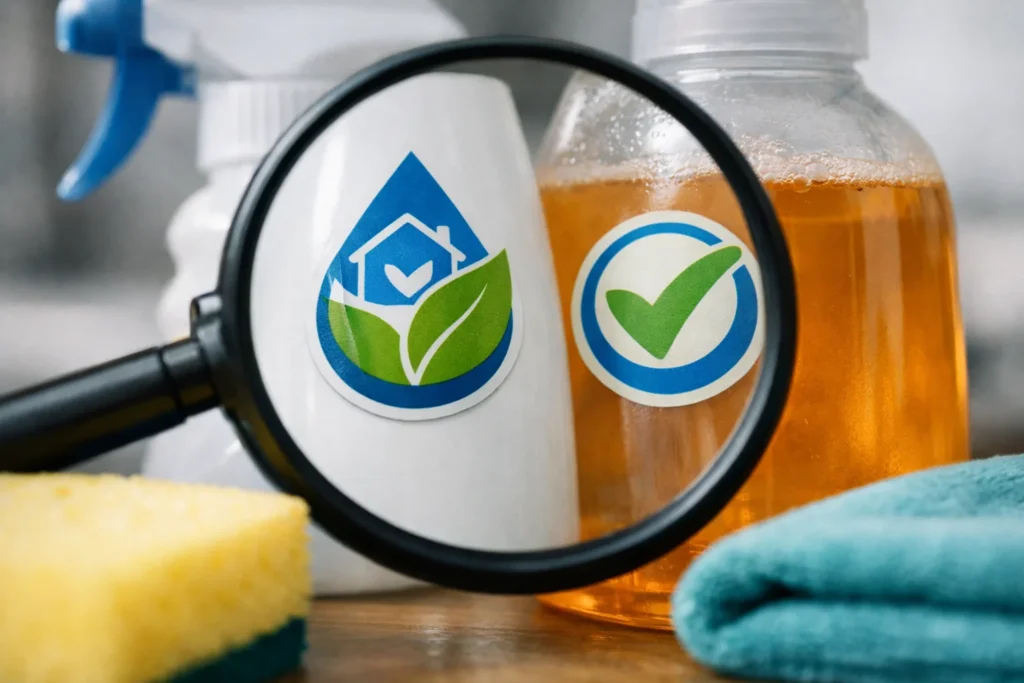
Walk down a cleaning aisle and the words “natural,” “eco-friendly,” and “green” cover nearly every bottle. Most of those words are marketing and have no standard behind them. A few labels, however, come from programs that review ingredients or performance. Two worth knowing are EPA Safer Choice and Green Seal. Knowing what they check, and what they leave out, helps you read a label with confidence.
What EPA Safer Choice means
Safer Choice is a labeling program run by the U.S. Environmental Protection Agency. Products carrying the label have had every ingredient reviewed against human health and environmental criteria. The program covers many categories, including all-purpose cleaners, laundry products, and dish soaps. Details about the program and a searchable product list are available on the EPA website.
The label does not mean a product is harmless. It means the formula met the program’s criteria for its function, and that the ingredients were reviewed. You still need to follow the directions, wear gloves when the label says to, and keep the product out of children’s reach.
What Green Seal means
Green Seal is an independent nonprofit that develops standards and certifies products and services against them. Its cleaning product standards consider factors such as health and environmental effects, performance, and packaging. A certified product has been assessed against that standard by a third party. Like Safer Choice, it is not a promise that the product is risk-free in every use.
Side-by-side comparison
| Label | What it checks | Where you see it | What it does not mean |
|---|---|---|---|
| EPA Safer Choice | Each ingredient reviewed for human health and environmental criteria; performance within the product category | Front or back of cleaners, laundry products, and dish soaps | Not “nontoxic” or safe to swallow; does not replace reading directions |
| Green Seal | Product tested against an independent standard that covers health, environment, and performance | Front labels, institutional and household cleaners | Not a guarantee that it is safe for every surface, person, or pet |
| “Natural,” “eco-friendly,” “green” (no certification) | Nothing specific; no required standard | Anywhere on the package | Does not mean safer, plant-based, or tested |
Signals you should still read
Certification logos tell you about one part of a product. The warnings tell you what to do in your own home. Look for these signal words on the front of the bottle:
- Caution: lower hazard, but still follow directions.
- Warning: moderate hazard, such as eye or skin irritation.
- Danger: the highest hazard category, such as corrosive or flammable products.
- Poison: toxic if swallowed. Keep this far from children and pets.
The label also lists first-aid steps, ventilation advice, and storage instructions. Keep products in their original container so you do not lose that information.
Safety data sheets
A safety data sheet, or SDS, is a document that manufacturers provide for chemical products. It lists ingredients of concern, hazards, handling advice, and emergency measures. You can usually find it on the manufacturer’s website by searching the product name. Read it for any product you use frequently, especially if someone in the house has asthma or skin sensitivity.
How to choose a cleaner
- Start with the job. A glass cleaner and a toilet bowl cleaner do not need the same formula.
- Read the front panel. Look for signal words and certification marks.
- Check the back. Directions, dilution, and first-aid information live there.
- Use the least product that works. More does not clean better.
- Never combine products. Each one is tested alone.
A certified label is a reasonable tiebreaker when two products otherwise look similar, but it is not a substitute for care. For a plan that helps you keep a short list of products and a steady routine, see our guides in routines and planning.